SMN NEWS: A Journey to Relational Mentoring - Interview with Charlie Martin from the Wise Group
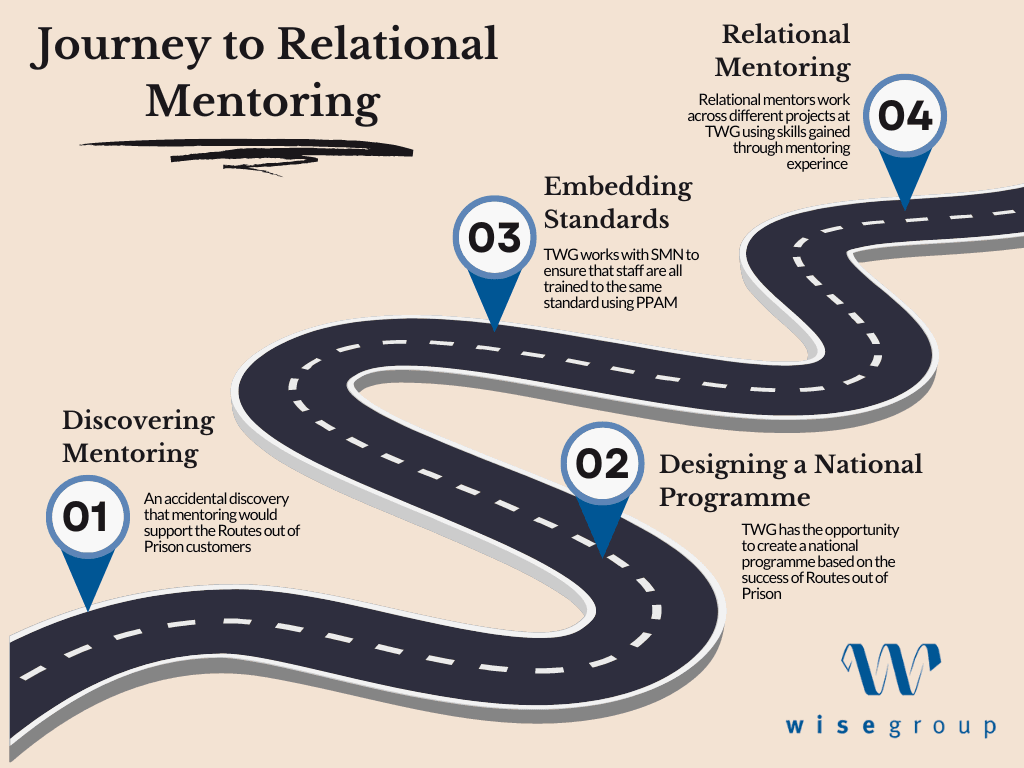
In this interview, our Marketing, Communications and Support Lead Katya Allcott asks Charlie Martin of the Wise Group to guide her through the Wise Group's journey to relational mentoring. They explore the difference between mentoring and support work, how to create the justice sector's version of the Big Mac and why ultimately #MentoringWorks.
Charlie Martin is something of a legend in Glasgow's third sector. I have only had the pleasure of knowing him properly since he joined the Scottish Mentoring Network board of directors in 2018 - but I've known him by reputation since the very start of my third sector career. I say 'career', I have luckily only had two jobs since I found my way to the voluntary sector. My first 'real job' was in an equalities charity where a focus of our work was on supporting the minority within a minority - BME young offenders. This charity was one of the partner organisations that delivered New Routes mentoring in Scotland. So I knew of Charlie's reputation for leading this movement that had mentoring at its heart.
Now that I've been working with Scottish Mentoring Network for some years, I wanted to understand where and how it all started, to share with you all Charlie's wisdom of using mentoring to change lives. I didn't expect this conversation to be quite so full of expletives (from both of us I might add!) - but on reflection I think that's just because we are both so passionate about mentoring. In telling the story of the journey to The Wise Group's Relational Mentoring approach, Charlie gifted me many a valuable life lesson.
However, the one that stuck out in my mind was,
"Never compromise on quality."
Those words have stuck with me ever since - not just because it's something that we passionately believe in at SMN, but because in a world where leaders can be disgraced and show contempt for their own rules, upholding quality is something I think we should all be aspiring to.
In the context of the Wise Group's mentoring journey, delivering their services with quality and dedication has been a core component - despite the fact that they discovered mentoring by accident. The New Routes programme, originally called 'Routes Out of Prison', typically delivered support work to their customers. And although this work was helpful, 9 out of 10 were ending up back in prison. Of course, Charlie wanted to understand why - and what he discovered was that the customers had developed learned helplessness. So something had to change.
"Let's get the customer to tell us what their issues are rather than us telling them what their issues are. So, [...] let's make it person centred, and then let's start looking at it and saying to the customer, well, do you know what? I can help you with A, B, C, D, E, I can't and won't help you with X, Y, Z - but I actually expect you to do M and L and P."
With this new approach came resistance, but when the customers realised that this was about empowering them, and improving their self efficacy - customers developed a buzz from becoming more successful in themselves.
This continued for around 18 months, before an unexpected opportunity arose. Through Charlie's work with the Scottish Government and then Justice Secretary Kenny MacAskill, the Wise Group had the chance to create a national programme for prison throughcare. At a Government level, there was a drive to create a consistent level of care across the country, and create efficient (i.e. value for money) care for prison leavers. This was where the accidental discovery of mentoring came in to play.
The support mechanism (mentoring) was decided - but the method of delivering it nationally was still unclear. "We didn't have a footprint, we didn't have a presence over 32 local authorities across and yet we had said we would do away with this postcode lottery." The answer? Geographic partners.
And so to ensure that there was consistency across these delivery partners, there had to be processes put in place. A paper trail of evidence.
The community justice Big Mac.
But to fully ensure that every staff member in this partnership was mentoring to the same standard, the Wise Group wanted them to go through a recognised qualification.
Enter Scottish Mentoring Network - and soon all staff were being trained using the Professional Practice Award in Mentoring (PPAM). This was another tool in the box that enabled the New Routes mentors to deliver consistency across the country. It also helped to create really good mentors, mentors who don't give up on their customers. The empowerment of the customers in turn produced additional, unexpected positive outcomes - so where the Scottish Government had been looking for how many more boxes could be ticked, what actually happened was that mentors stuck by their mentees - and through that empowerment and relationship building, additional outcomes could be seen.
The benefits were not only felt for the customers (mentees) though. Once the mentors had learned the mentoring process, they could take those skills and apply them to other areas of the Wise Group's business. When financial inclusion mentors were needed in Inverclyde, instead of recruiting and training new mentors, New Routes team members were able to take on the new opportunity.
"Not because they knew anything about financial inclusion, but because they knew about mentoring." The experience in mentoring has given them a fresh outlook when taking on new roles within the Wise Group. And like when you throw a pebble in a pond, the ripple effect has been felt across the whole organisation.
And in reality, the ripple effect of the New Routes mentoring had not just been felt within the Wise Group, but across partner organisations too.
"So it's kind of like, guilty by association... we want to be associated with that, so we'll call it that...People want to be known as mentors, seen as mentors."
To many working in the justice sector, New Routes is held up as the gold standard of interventions for prison leavers. Perhaps this is due to the longevity of the programme. What started out as a programme with two years' worth of funding is now in it's eleventh year. With a well evidenced and impactful programme, the Wise Group were continuously successful in gaining funding for the programme.
Once again, there's a lesson there in quality and consistency - and understanding the most important aspect of mentoring: the relationship between mentor and mentee. This, in a nutshell, is why the Wise Group now talk about their mentoring as being 'relational'. They ensure that there are manageable mentor workloads, in order that they can concentrate on developing the relationships with their mentees.
But what about the relationship between Scottish Mentoring Network and The Wise Group? Charlie describes it as 'symbiotic - we need each other'. The Wise Group team understand the value of giving mentors the PPAM training before they go out to mentor, which in some cases means literally to save lives. The Wise Group endorses the network through holding the Quality Award.
And once again, there's something to be said about relationships - our small team at SMN, who have all been in post now for over three years, have built the consistent relationships with the staff at the Wise Group. I think this can only be helpful.
In a context where organisations face precarious funding situations that inevitably lead to high staff turnover, it is hard to advocate for building long lasting relationships between organisations. But the truth is that this is what we've seen work for the Wise Group and Scottish Mentoring Network. Not only have they invested in us financially, but they have invested in their staff - and that level of investment has created prepared, confident and dedicated employees who want to spend their careers with the Wise Group.
However, I'm not saying that money is everything of course. What I really want to say is that #MentoringWorks. Mentoring works to give the staff at the Wise Group a set of transferrable skills which they can use day in, day out. Not only do they mentor their mentees (with complicated situations facing their re-entry into the community), but with their friends and family too, (who may be struggling with the cost of living crisis and be in need of help and advice). The mentoring skills they learn at work will last them a lifetime.
Finally, I want to return to that life lesson that Charlie gifted me - "Never compromise on quality" - because I think it summarises how I feel about mentoring. When you learn the fundamentals about mentoring, (the structure, the skills required, the models which underpin it), you are armed with an invaluable skill set. You will know the difference between giving unwanted advice and supporting someone to make the right decision for them. You will know how to actually listen. You'll recognise the strengths in yourself that not only help your mentees but also help you on your journey through life.
Fully commit to the mentoring process, and watch amazing things happen.
If you would like to learn more about how your organisation can utilise the Professional Practice Award in Mentoring for your team, please get in touch with us on info@scottishmentoringnetwork.co.uk.